North Node Calculator
Find your North Node zodiac sign from your birth details.
Enter your birth date and, if you have it, your birth time to calculate your North Node placement. Your North Node is not a planet or physical object. It is one of the two lunar nodes: a calculated point where the Moon’s orbital path intersects the ecliptic. It is also called the Ascending Node.
In astrology the North Node is commonly interpreted as a symbol of growth, development, and qualities you may be encouraged to explore over time. That interpretation is different from your Sun, Moon, or Rising sign, so finding your North Node adds another layer to a natal chart.
How to Use the North Node Calculator
- Enter your birth date. This is the main information needed to identify your North Node sign.
- Add your birth time if you know it. The North Node moves slowly, so the sign can often be identified from the date alone. Exact time matters more for a complete natal chart, especially houses and placements near a sign boundary.
- Select Calculate North Node. The tool returns your True Node and Mean Node position, plus your opposite South Node.
- Explore the meaning of your result. Once you know the sign, you can read the themes traditionally associated with that placement below.
What Is the North Node?
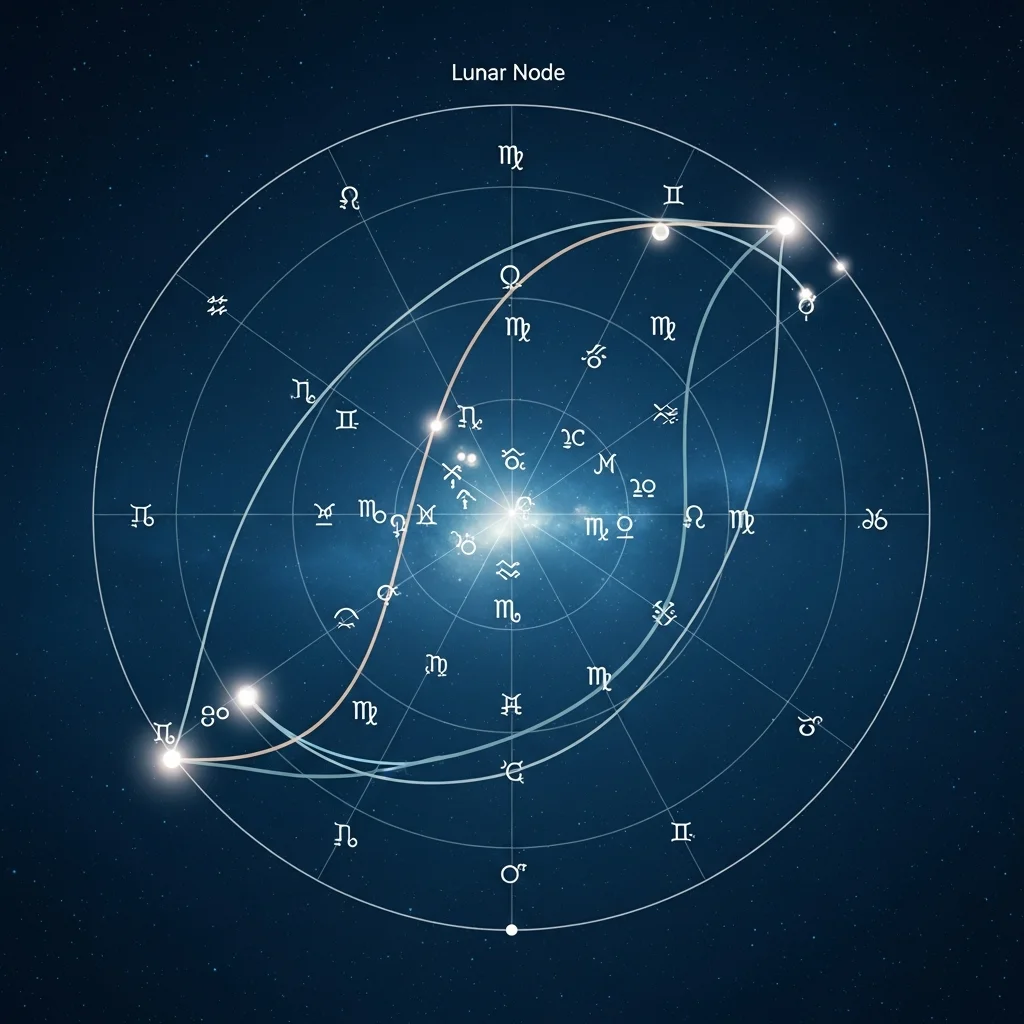
The North Node is the point where the Moon crosses the ecliptic while moving from south to north. The opposite point is the South Node, or Descending Node. Together they form the lunar nodal axis. The ecliptic is the reference plane associated with Earth’s orbit around the Sun; because the Moon’s orbit is tilted relative to that plane, its path intersects it at two points.
So the North Node is not a planet, not a star, and not a physical celestial body. It is a calculated point based on the relationship between the Moon’s orbit and the ecliptic. Astrologers give these astronomical points symbolic meaning — these are astrological interpretations rather than established scientific effects.
How the position is calculated
This calculator derives the node directly from standard astronomical formulae rather than a fixed date table, and reports both the True Node and the Mean Node so you can see when they disagree.
What Does Your North Node Mean in Astrology?
Your North Node is usually read as a direction for growth rather than a description of your existing personality. That is why it can feel different from a Sun or Moon sign: the Sun is commonly used to describe identity and self-expression, the Moon is associated with emotional responses and needs, while the North Node points toward themes astrologers believe you may develop through experience.
A full reading can consider the North Node sign (the qualities involved), the house (the area of life where they show up), the degree (exact position), aspects to other placements, and the South Node opposite it. A calculator gives you the placement; interpretation comes afterwards.
North Node and South Node
The two nodes are always directly opposite each other, forming a 180° axis, so knowing one tells you the other. The North Node is associated with development and unfamiliar territory; the South Node with familiar tendencies, experiences, or skills. The South Node is not something to reject — in many approaches its themes represent abilities that become more useful when balanced with North Node qualities.
| North Node | South Node |
|---|---|
| Aries | Libra |
| Taurus | Scorpio |
| Gemini | Sagittarius |
| Cancer | Capricorn |
| Leo | Aquarius |
| Virgo | Pisces |
| Libra | Aries |
| Scorpio | Taurus |
| Sagittarius | Gemini |
| Capricorn | Cancer |
| Aquarius | Leo |
| Pisces | Virgo |
Want the opposite point on its own? Use the South Node Calculator.
North Node by Zodiac Sign
Astrology does not treat all North Node placements the same way; each sign carries a different set of themes.
North Node in Aries
Independence, initiative, self-direction, and learning to act from your own perspective.
North Node in Taurus
Stability, patience, simplicity, personal values, and a steadier relationship with resources.
North Node in Gemini
Curiosity, communication, asking questions, and remaining open to different viewpoints.
North Node in Cancer
Emotional awareness, connection, home, family, and letting personal needs matter alongside achievement.
North Node in Leo
Creativity, self-expression, confidence, and a willingness to be personally visible.
North Node in Virgo
Practical skills, organisation, useful work, discernment, and bringing structure to ideas.
North Node in Libra
Cooperation, partnership, diplomacy, balance, and considering another person’s perspective.
North Node in Scorpio
Emotional depth, trust, transformation, vulnerability, and moving beyond the completely familiar.
North Node in Sagittarius
Broader perspectives, exploration, meaning, honesty, and developing a personal philosophy.
North Node in Capricorn
Responsibility, structure, long-term goals, self-discipline, and owning your direction.
North Node in Aquarius
Individuality, community, wider social perspectives, and contributing ideas beyond personal concerns.
North Node in Pisces
Compassion, intuition, acceptance, imagination, and loosening a need for control or certainty.
These are astrological interpretations, not scientific personality classifications. Your North Node sign is best considered alongside the rest of your natal chart rather than as a standalone definition of who you are.
North Node by House
Your North Node sign and house answer different questions.
| Placement | What it describes in astrology |
|---|---|
| North Node sign | The qualities or style associated with your development |
| North Node house | The area of life where those themes are expressed |
| North Node degree | The precise zodiac position |
| North Node aspects | How the Node relates to other chart placements |
House placement requires a complete birth-chart calculation, which makes birth time and birthplace far more important than they are for identifying the sign alone. A North Node in the 10th house may be read through career and long-term ambitions, while the 4th house is read through home, family, and private life. The result depends on the house system used, so it should never be inferred from the zodiac sign alone. See the North Node House Calculator for the full breakdown.
Does Birth Time Matter for a North Node Calculator?
For the North Node sign, your birth date is often enough when the Node sits well within a sign — the lunar nodes move slowly, which is why date-based tables can identify a sign without an exact time. Birth time becomes more useful when your birth falls close to a sign change, when you want the exact degree, when you want the house placement, when comparing against other time-sensitive chart factors, or when building a complete natal chart.
Cafe Astrology, for example, notes that sign-change dates can require more precise chart calculation when a birth date falls near a transition, and distinguishes between the True and Mean North Node. If you don’t know your exact time you can still start with the sign; for detailed interpretation, accurate birth information is preferable.
True North Node vs. Mean North Node
You may see slightly different results on different astrology websites, because calculators can use different approaches to the lunar node.
| True North Node | Mean North Node |
|---|---|
| Accounts for the node’s varying motion | Uses an averaged motion for the node |
| Shows more short-term variation | Smooths the motion into an average |
| Differences matter most near a sign boundary | Useful for traditional date-range tables |
The two usually produce very similar placements, but a small difference matters when the Node is near a boundary between signs. Cafe Astrology notes that its North Node tables use the True North Node. This calculator shows you both, so you can see immediately whether your birth date is one of the ambiguous ones.
Why Can Two North Node Calculators Give Different Results?
If two calculators disagree, it does not automatically mean one is broken. Common reasons:
- True Node vs. Mean Node — different methods produce slightly different positions.
- Sign boundary — a small difference matters near 0° or 29° of a sign.
- Birth-time handling — tools may process time and time zone differently.
- Ephemeris data — software can use different underlying datasets or settings.
- Rounding — one may display a rounded degree while another shows more precision.
For most people these differences are minor, and become noticeable only when the Node is close to changing signs.
North Node vs. Sun, Moon, and Rising Sign
These placements are often confused because they all appear in natal-chart readings, but they represent different concepts.
| Placement | Common astrological use |
|---|---|
| Sun sign | Identity, self-expression, and sense of self |
| Moon sign | Emotional responses, instincts, and inner needs |
| Rising / Ascendant | The sign rising on the eastern horizon; outward approach and first impressions |
| North Node | Growth themes and qualities associated with moving beyond familiar patterns |
North Node vs. Ascending Node
These are two names for the same lunar node. “Ascending” refers to the Moon crossing the ecliptic from south to north; the opposite point is the Descending Node, commonly called the South Node. NASA’s description of orbital nodes uses the same ascending and descending terminology for points where an orbit crosses a reference plane. So North Node, Lunar North Node, Moon’s North Node, Ascending Node, and Ascending Lunar Node all refer to the same point in natal astrology.
Is the North Node a Planet?
No. The North Node is a calculated point, not a physical planet or celestial body. It is defined by the intersection of the Moon’s orbital plane with the ecliptic, and the South Node is the corresponding opposite intersection. This distinction matters because birth charts include both physical celestial bodies and mathematical points.
Can Your North Node Change?
Your natal North Node does not change after you are born. It is calculated from your birth information and stays the same throughout your life. The lunar nodes themselves do keep moving through the zodiac as part of their astronomical cycle — that is your transiting North Node, which is different from your natal placement. When someone asks “what is my North Node?”, they normally mean the natal one.
What If You Don’t Know Your Exact Birth Time?
You can still begin with your birth date. If it falls comfortably within a North Node sign period, the sign can usually be identified without an exact time. If your birthday is close to a sign transition, the result deserves more care, because calculation method or precise birth information may change the placement. For the house, a complete natal chart, or other time-sensitive placements, finding your birth time matters much more. Where possible, use the time recorded on an official birth record rather than an estimate.
How Accurate Is a North Node Calculator?
The calculation itself is mathematical: the lunar node is determined from the Moon’s orbital relationship to the ecliptic, and a calculator automates that using astronomical data and a defined method. Interpretation is a separate matter — astrology assigns symbolic meanings to the placement, and those should not be confused with scientifically established predictions about personality or future events.
For the most reliable result, use the correct birth date, the correct birth time when available, consistent time-zone information for detailed chart work, a clearly stated calculation method when comparing calculators, and extra care when the Node sits close to a sign boundary.
Frequently Asked Questions
What is a North Node Calculator?
A North Node Calculator is an online tool that works out the zodiac position of the lunar North Node from your birth information, so you don’t have to determine the placement manually.
How do I find my North Node sign?
Enter your birth date into the calculator above and press Calculate. Adding your birth time gives greater precision, which matters most for detailed natal-chart work or dates near a sign transition.
What information do I need?
For the North Node sign, your birth date is enough, with birth time optional. A complete natal chart needs more, including your birthplace, because houses and other chart factors depend on location and time.
Is the North Node the same as the Ascending Node?
Yes. The North Node is also called the Ascending Node because it marks the point where the Moon crosses the ecliptic moving from south to north.
Is the North Node the same as the South Node?
No. They are opposite points on the same nodal axis. The South Node sits 180° from the North Node.
Is the North Node the same as my Sun sign?
No. Your Sun sign and North Node are calculated from different astronomical factors and play different roles in astrology.
Is the North Node the same as my Moon sign?
No. Your Moon sign is the zodiac position of the Moon at birth. The North Node is where the Moon’s orbit intersects the ecliptic.
Is the North Node the same as my Rising sign?
No. The Rising sign, or Ascendant, is the sign rising on the eastern horizon at a specific birth time and location. The North Node is a lunar-node calculation.
What is the difference between True and Mean North Node?
They are two approaches to calculating the node’s position. True Node accounts for the node’s varying motion; Mean Node uses an averaged motion. They usually agree, but can differ slightly around sign boundaries. This calculator shows both.
Can two North Node calculators give different results?
Yes, particularly if they use different calculation methods, handle birth information differently, or if your North Node is close to changing signs.
Does my North Node change during my lifetime?
Your natal North Node does not change. The transiting lunar nodes, however, keep moving through the zodiac.
Do I need my exact birth time?
Not always for identifying the sign. It becomes important for detailed chart calculations, including the North Node house, and for births close to a sign transition.
What does my North Node mean?
In astrology the North Node is commonly read as a symbol of development, growth, and qualities that may feel less familiar at first. Its meaning is usually considered together with the South Node, house, degree, aspects, and the rest of the natal chart.
Start With Your North Node
Your North Node is one small part of a natal chart, but it is a useful starting point for exploring lunar-node astrology. Enter your birth date, add your time if you know it, and calculate your sign. From there you can explore the opposite South Node and your house placement.
The calculation gives you the placement. What you make of the symbolism is up to you.